Frontend Architecture Audit: What It Is, When You Need One, and What Good Looks Like
Your frontend team keeps slowing down and nobody can say exactly why. A frontend architecture audit turns that vague feeling into a ranked, actionable list.
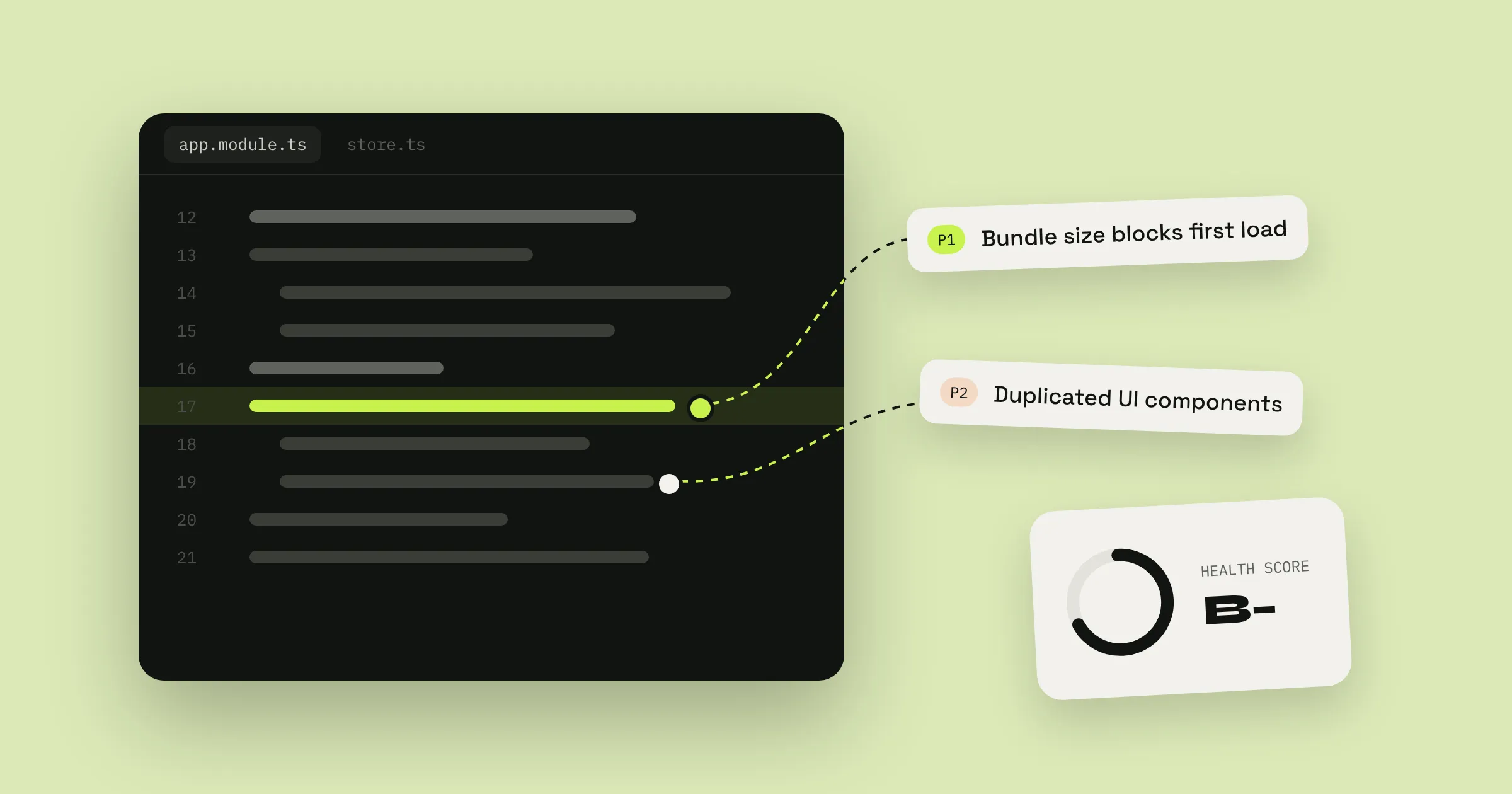
“Our frontend team keeps slowing down and nobody can say exactly why.” It is a sentence I hear often from founders and CTOs. The codebase works, features still ship, but every quarter each feature seems to cost a little more than the last one.
A frontend architecture audit is the diagnostic that turns that vague feeling into a ranked, actionable list. This article explains what a rigorous audit looks like, when it is worth doing, and what you should expect to get out of it. It is written from the side of the person doing the work, but it is meant for both the engineers who live in the code and the business leaders who pay for the delays.
In short
- A frontend architecture audit turns a vague sense of slowing delivery into a ranked, actionable list.
- Three or more signals, such as inflating estimates, clustered bugs and slow onboarding, are a pattern worth diagnosing.
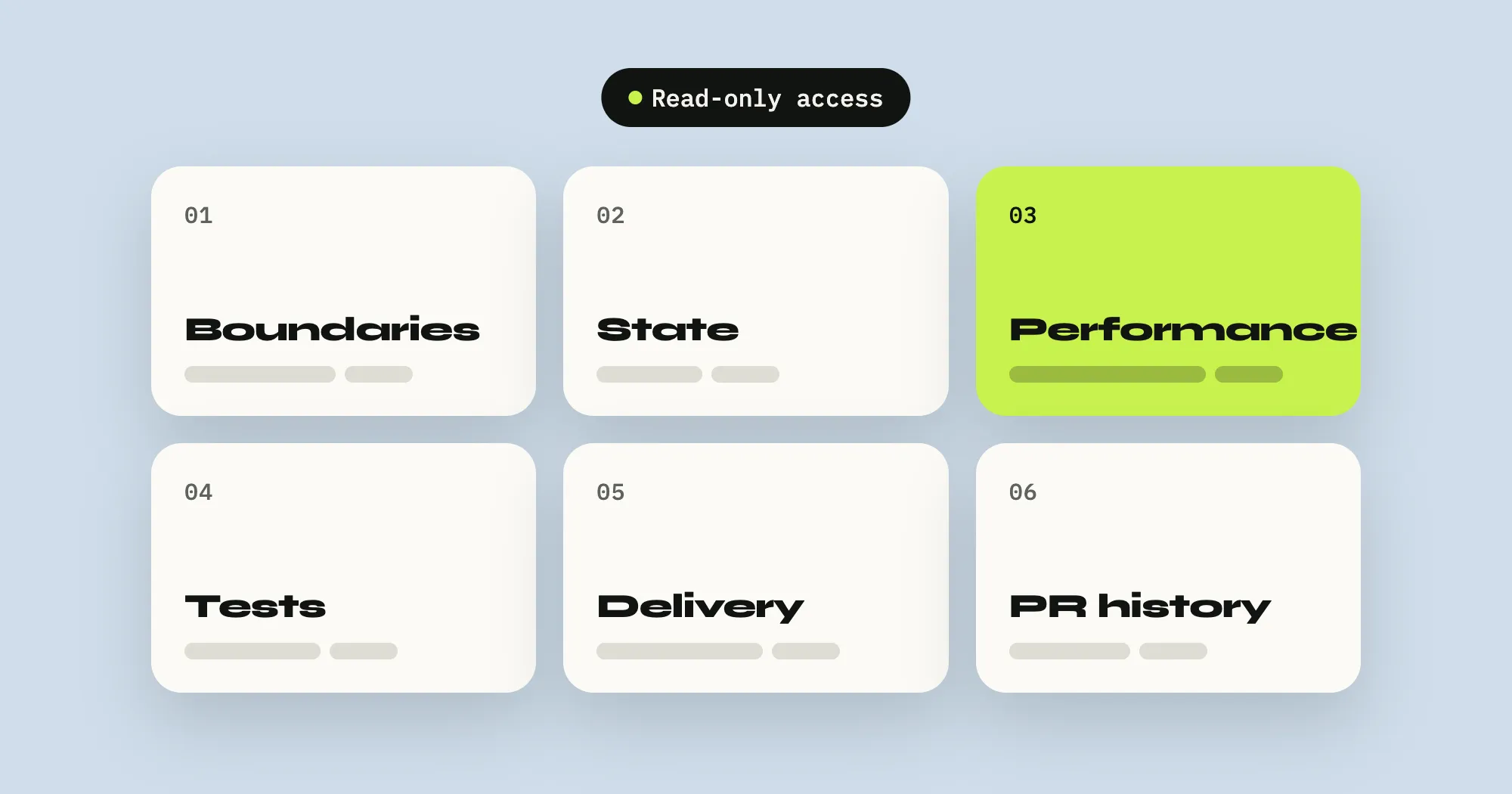
- A real audit starts read-only and covers boundaries, state, performance, tests, delivery and pull request history.
- A good report ranks findings by impact versus effort, gives a first step for each one, and says what not to fix.
- The audit has worked when the team owns the new standards and no longer needs the auditor.
What an audit gives the business
For a technical leader, an audit is a structured second look at the architecture: boundaries, state, performance, tests and delivery. For a founder or CEO, the value is simpler. It answers questions that are otherwise hard to get a straight answer to:
- Why is delivery slowing down, and is it the code, the process, or the team size?
- Where is the risk? Which parts of the product are fragile, and which are fine?
- What should we fix first, and what can we safely leave alone?
- Is a rewrite really necessary, or would a few targeted changes remove most of the pain?
The output is not a lecture about best practices. It is a decision tool: a short list of problems, ranked by how much they cost the business, with a first step for each one.
The signals that you need one
You probably do not need an audit because someone dislikes your framework choice. You probably do if several of these sound familiar:
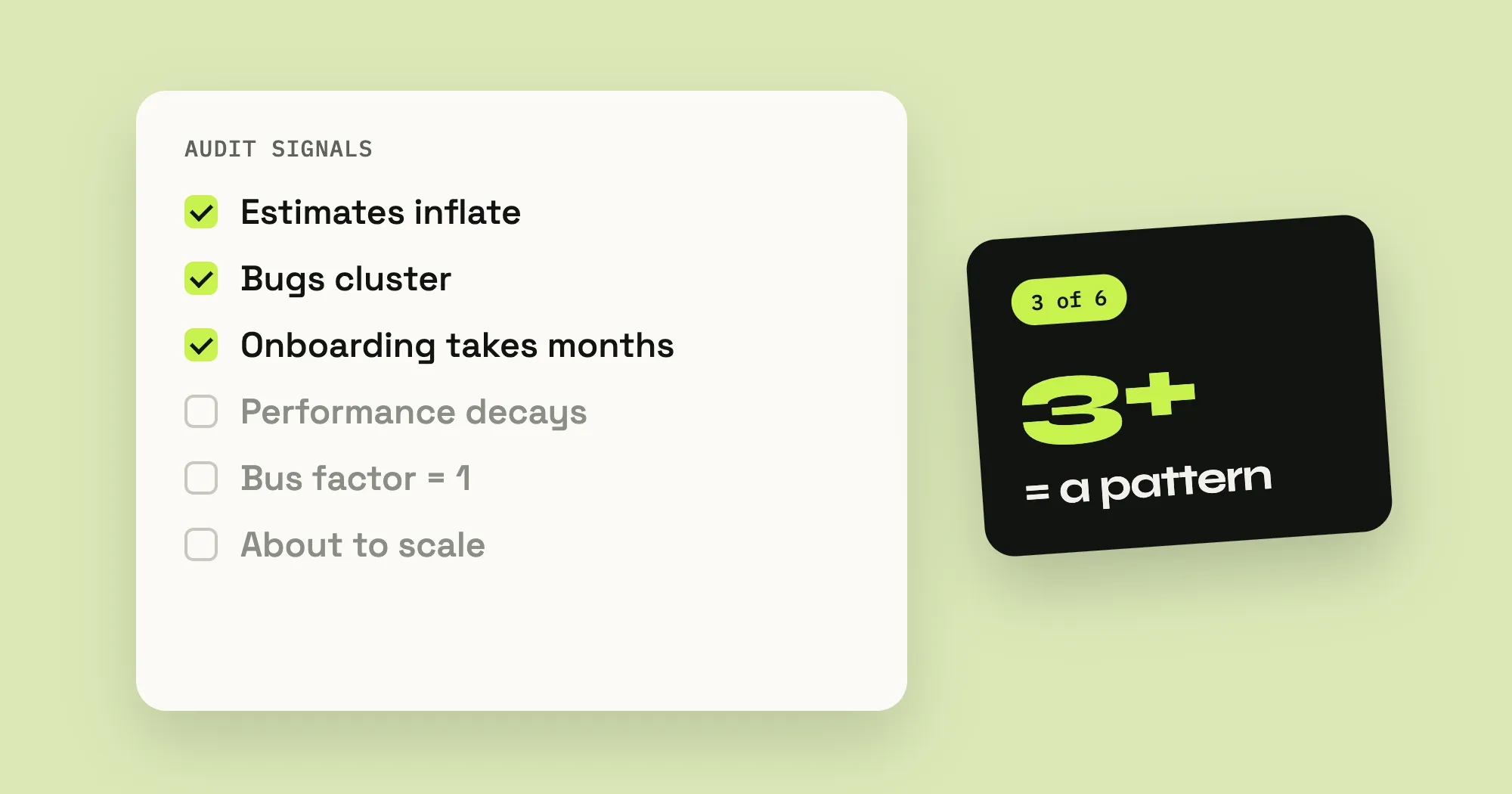
- Estimates inflate. A screen that took a week last year now takes noticeably longer, and the team cannot point to a single cause.
- Bugs cluster in the same places. The same module keeps breaking, no matter who touches it.
- Onboarding takes months. New engineers cannot hold the architecture in their heads, because there is not one architecture to hold. There are several, from different eras of the product.
- Performance decays. Bundle size and load time creep up, and nobody owns the number.
- The bus factor is one. A single engineer understands the state management, and they are tired.
- You are about to scale. Doubling the team on a codebase with unclear boundaries tends to increase collisions faster than output.
One of these is a normal week. Three or more is a pattern worth diagnosing before you hire more people into it.
What a real audit covers
An opinion formed in a two-hour call is not an audit. A useful audit starts read-only: access to the repository, the CI pipelines and the pull request history, before any conclusions are drawn. These are the dimensions that matter most.
1. Module boundaries and dependency direction
Can a change stay local? One of the best predictors of feature cost is how far a typical change ripples. If touching the checkout screen means editing shared utilities, three services and a global store, every feature will be expensive.
2. State management
Where does data live, who changes it, and can anyone answer that without reading the code? A common finding is accidental state machines spread across many components, where the real rules of the product are scattered and implicit.
3. Performance, measured
Bundle composition, code splitting, rendering behavior, how chatty the data layer is. All of it with numbers, because “it feels slow” is not a work item. Fixes should come with before and after measurements, not impressions.
4. Test posture
Not the coverage percentage, but where the coverage is. Tests on the flows that pay the bills, such as authentication, checkout and data integrity, are worth more than tests everywhere else combined.
5. Delivery pipeline
How long does it take from merge to production? Painful deploys happen rarely, and deploys that happen rarely tend to be more painful. A slow, fragile pipeline quietly taxes every change the team makes.
6. Pull request history as evidence
The git log is honest. Where changes need many review rounds, where the same files churn in every pull request, where reverts cluster: that is the architecture telling you where it hurts. This evidence is especially useful for non-technical leaders, because it ties opinions to observable patterns.
What the deliverable should contain
A good audit report is short enough to read and specific enough to act on.
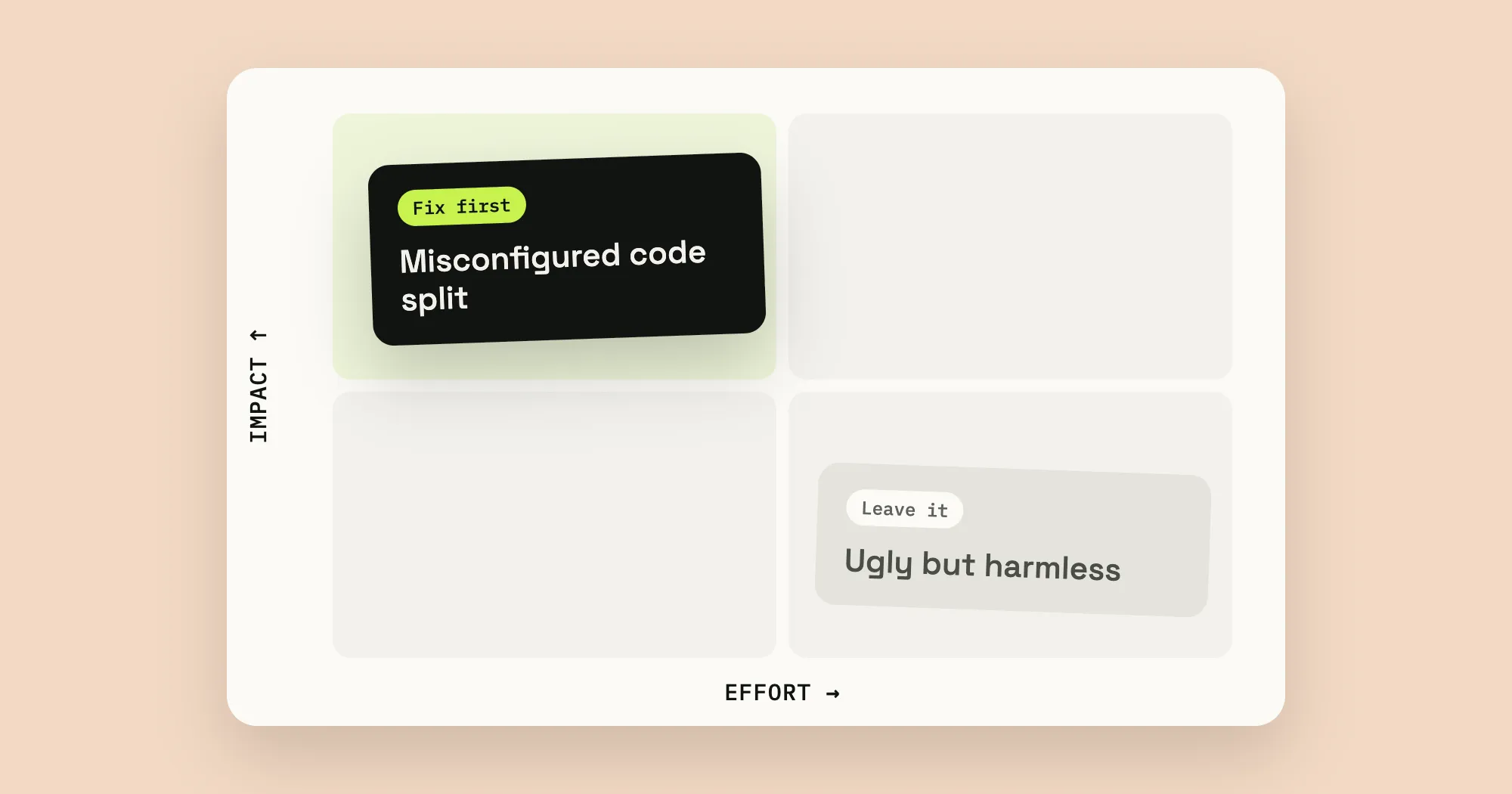
- Findings ranked by impact versus effort, not by how alarming they sound. A misconfigured code split that slows down every user outranks an elegant but theoretical layering violation.
- A concrete first step for every finding. “Improve state management” is not a finding. “Move the pricing state out of these four components into one clear owner, starting with this screen” is.
- The order to fix things in. Dependencies between fixes often matter more than the fixes themselves. Some cheap wins unlock the expensive ones.
- What not to fix. Sometimes the most valuable line in a report is “this part is ugly but harmless, leave it.” Rewriting working code for aesthetics is how audits waste money.
Watch out
What it should not contain: a recommendation to rewrite everything in the auditor’s favorite framework. A rewrite recommendation should be rare, justified with evidence, and come with a migration plan that keeps features shipping.
An example from practice
From practice
On a US corporate meal benefits platform where I led the frontend chapter, I worked on migrating a legacy AngularJS application to modern Angular. The team did not stop and rewrite it. The application was moved route by route, so old and new code ran side by side while product work continued. Two other Angular applications were rebuilt with a modern architecture, lazy loading and proper state management, because in their case starting fresh was the simpler path.
What made both approaches workable were the same things an audit looks for: clear boundaries (routes were natural units of migration), tests that survive change (unit tests with Jasmine and Karma, plus end-to-end tests with Cypress that check behavior through the browser), and a CI/CD pipeline reliable enough to ship small steps often. The lesson is that the right fix is decided per system, and sometimes per module, not as a company-wide philosophy.
After the report: making it stick
The report is the easy part. Change sticks when someone works alongside the team while the first fixes land: pairing, code reviews, architecture sessions. The real product of an audit is not the document, it is the habits it leaves behind.
A few things tend to outlive any document:
- Lint rules and CI gates that encode the new standards, so they are enforced automatically.
- A definition of done the team actually follows, instead of a wiki page nobody opens.
- Clear ownership of the numbers that matter, such as bundle size or test health on critical flows.
From my time as a technical lead, where hiring, mentoring and setting standards were part of the role, the pattern was consistent: standards stick when the team owns them, not when they are handed down.
And the goal is exit. An audit that makes the auditor permanently necessary has failed.
Documented standards, a team that owns them, and a codebase boring enough to move fast in: that is what done looks like.
What it takes and what it is worth
The scope of an audit typically depends on the size of the frontend, how many applications are involved, and how much context the team can share. For a focused audit of a single mid-size frontend, it is usually a matter of weeks rather than months: time to read the code and its history, time to write and validate findings with the team, and an optional period of hands-on support while the top fixes land.
The comparison that matters for the business is the alternative. Another few quarters of slowly inflating estimates, or hiring more engineers into a codebase that absorbs their time, usually costs far more than a structured look at where the friction comes from. Unaddressed problems also compound, which is the core of the cost of technical debt.
Getting an outside view
An internal team can do much of this themselves, and often should. But people who work in a codebase every day get used to its pain points, and an outside view can make patterns visible faster and help leaders turn them into decisions.
I have been working in software for 10+ years, as co-founder and CTO of an AI-powered SaaS product, and leading frontend work on legacy migrations and rebuilds. If some of the signals above sounded familiar, my technology consulting page describes how I approach audits and architecture reviews, and software modernization covers what happens when the findings call for deeper change. A good first message is short: what you are building, and what is slowing you down.